€64.88 Ursprünglicher Preis war: €64.88€28.88Aktueller Preis ist: €28.88.
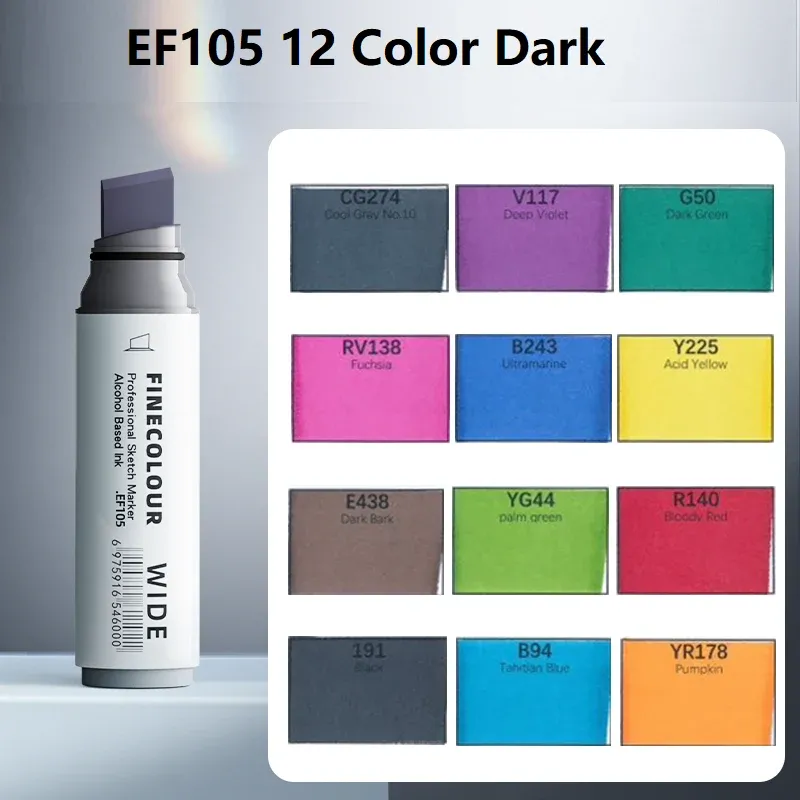
FINECOLOUR EF105 Wide-Tip Alcohol Marker Set of 12 — Professional 20mm Broad Chisel Sketch Markers for Large-Area Rendering, Background Fills & Poster Design | Fast-Coverage Layout Markers for Architecture, Fashion & Concept Art
Product Description:
One Stroke. Twenty Millimeters of Coverage.
The FINECOLOUR EF105 is not a detail pen. It’s a 20mm wide-chisel layout marker built to fill large areas in a single sweep — backgrounds, sky gradients, fabric panels, building facades, and poster fields that would take dozens of strokes with a standard marker. Loaded with alcohol-based professional ink in a 12-color set, it’s the tool that turns a 30-minute fill job into a 3-minute one.
Specifications
Detail Spec
Brand
FINECOLOUR (法卡勒)
Model
EF105
Tip type
Broad chisel (single-tip)
Tip width
20mm (0.79 in)
Ink type
Alcohol-based dye ink
Set size
12 colors
Category
Wide-body layout / sketch marker
What 20mm Actually Means
A standard dual-tip marker’s chisel nib is 5–7mm wide. The EF105 is 20mm — roughly three to four times wider. Here’s what that multiplication does in practice:
Standard Chisel (6mm) EF105 Wide Chisel (20mm)
10 strokes to fill an A5 area
3 strokes to fill the same area
Visible stroke overlaps in large fills
Seamless, streak-free coverage in fewer passes
Ink dries between strokes → uneven tone
Ink stays wet edge-to-edge → uniform flat color
Acceptable for small-to-medium illustration
Purpose-built for large-format rendering
The math is simple: fewer strokes mean fewer overlap lines, fewer drying boundaries, and a cleaner, more professional result on any area larger than a business card.
Why Large-Area Fill Quality Matters
The single biggest visual difference between amateur and professional marker rendering is background quality. Streaky, uneven fills behind a beautifully drawn subject undermine the entire piece. The EF105 eliminates this problem mechanically — the 20mm nib lays down enough ink in a single pass to maintain a wet edge across wide areas, allowing each stroke to melt into the next before either dries.
This is the same principle behind professional house-painting rollers versus small brushes — wider application means fewer seams and a more uniform finish.
Alcohol Ink at Scale
The EF105 uses the same alcohol-based dye ink platform as FINECOLOUR’s illustration markers, optimized for wide-nib delivery:
12-Color Set — The Background Palette
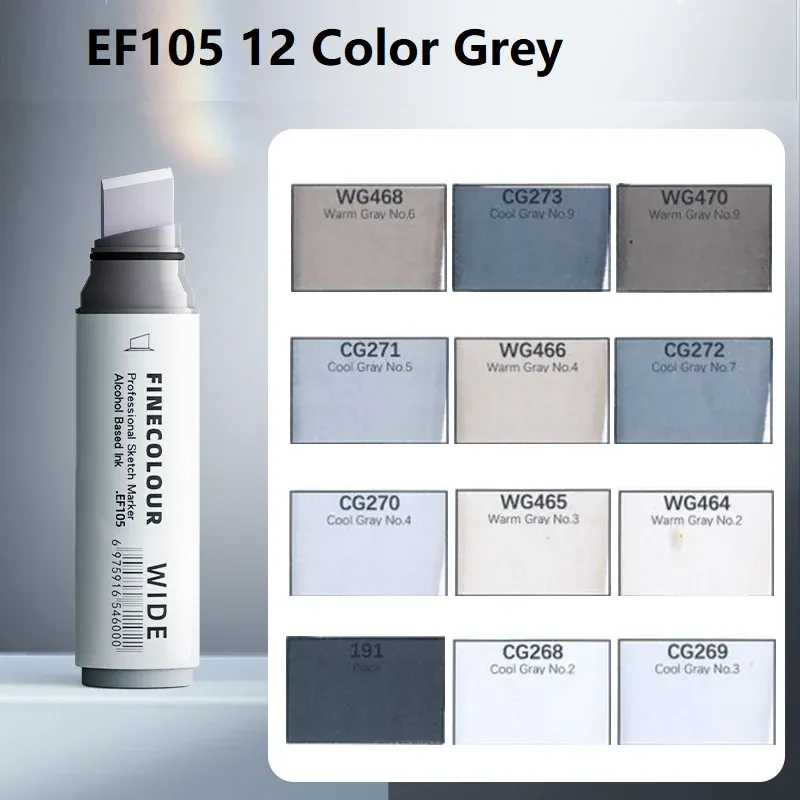
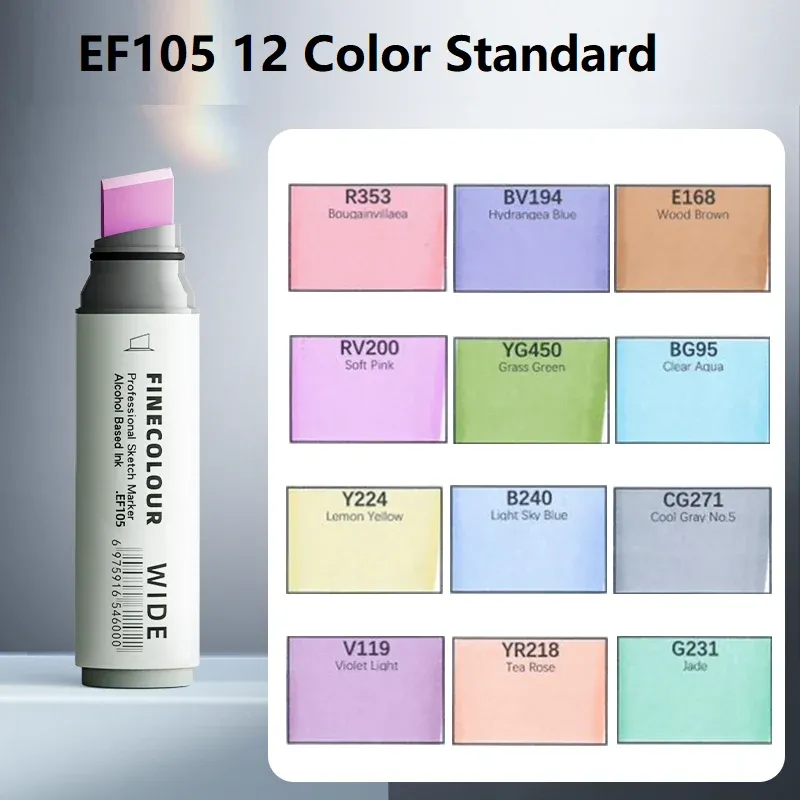
Twelve colors sounds limited until you understand what wide markers are used for. The EF105 palette is built around the large-area needs that standard marker sets underserve:
Color Category Role
Sky blues (light, medium)
Daytime skies, water reflections, atmospheric perspective
Warm greys
Concrete, stone, shadows on warm-toned subjects
Cool greys
Metal, glass, overcast skies, cool shadows
Greens
Foliage masses, landscape backgrounds, terrain
Earth tones
Ground planes, wood surfaces, kraft textures
Pale warm tint
Skin-tone base washes for large figure work
Deep values
Night scenes, high-contrast shadow anchoring
Neutral light
Paper-tone blending, highlight softening, value transition
These are the colors you burn through fastest in any marker collection — the ones that do the heavy lifting on every piece while your 48- or 72-color detail set handles the small stuff.
Who Needs a 20mm Marker
Architectural designers & students
Rendering building elevations, section cuts, and site plans at A3 or larger. The EF105 fills sky, ground plane, and shadow areas in seconds — the parts of an architectural rendering that consume the most time and the most ink.
Fashion designers & illustrators
Filling fabric panels, background washes, and textile swatches on croquis templates. A single EF105 stroke covers an entire garment panel, maintaining the flat, even color that fabric rendering demands.
Concept artists & entertainment designers
Blocking in value studies, mood compositions, and environmental thumbnails at speed. The wide nib encourages bold, decisive mark-making — the opposite of the timid, overworked fills that slow down concept development.
Poster & display designers
Hand-lettering backgrounds, POP display coloring, and presentation board fills. The EF105 covers poster-board areas that would require dozens of passes with a standard marker.
Art directors & creative leads
Quick comps, storyboard backgrounds, and client-facing concept sketches where speed and polish are equally critical.
Manga & comic background artists
Toning large background areas — skies, interiors, night scenes — before detail overlays. The EF105 replaces screentone application for artists who prefer hand-colored backgrounds.
Set designers & scenic artists
Rendering stage sets, backdrop color studies, and scenic elevation drawings at scale.
Workflow — How the EF105 Fits Your Existing Setup
The EF105 is not a replacement for your standard markers. It’s the first and last step in a rendering workflow:
Step 1: Base fill (EF105)
→ Lay down large-area background colors — sky, ground, shadow masses, fabric panels
Step 2: Detail rendering (standard dual-tip markers)
→ Use your FINECOLOUR EF100, Copic, or other dual-tip set for subject rendering, blending, and detail work
Step 3: Final touch-up (EF105 again)
→ Unify background edges, smooth transitions between detail zones and fills, darken shadow areas with a second pass
This base → detail → unify workflow is standard in professional marker studios and design schools. The EF105 handles Steps 1 and 3 — the stages where wide coverage matters more than precision.
Paper Recommendations
Paper Performance
Marker paper (70gsm, coated)
Ideal — minimal ink absorption, maximum blending time, no bleed-through
Layout bond paper
Excellent — designed for marker rendering; smooth, translucent, fast-drying
Bristol board (smooth)
Very good — crisp fills, vibrant color; heavier ink consumption
Presentation board / foam board
Good — large-format fills for client presentations
Cardstock (coated)
Functional — even fills, fast drying, limited blending
Watercolor paper
Not recommended — excessive texture causes uneven ink distribution; heavy ink waste
Copy paper
Not recommended — immediate bleed-through; ink consumption is extreme
Frequently Asked Questions
Can I use the EF105 for detail work?
The 20mm chisel can produce surprisingly fine lines when used on its corner edge — approximately 1–2mm. But for true detail work below 2mm, use a standard dual-tip marker. The EF105 is optimized for coverage, not precision.
How does a 20mm marker compare to using a Copic Wide or Copic Various Ink with a cotton pad?
The Copic Wide marker is the closest direct competitor at 21mm tip width. Performance is comparable. The FINECOLOUR EF105 offers a lower per-marker cost with the same alcohol-ink chemistry and wide-nib format. Cotton-pad application with Various Ink produces the most uniform fills possible but is messier, slower, and harder to control — the EF105 is the practical middle ground between pad application and standard-width markers.
Do these markers smell?
Yes. All alcohol markers produce a solvent odor. The EF105’s larger nib deposits more ink per stroke, which means more alcohol evaporating per pass than a standard marker. Work in a well-ventilated space. The odor dissipates within minutes of the ink drying.
Can I refill these?
Check FINECOLOUR’s refill ink compatibility for the EF105 series. The wide-nib format consumes ink faster than standard markers, making refillability an important cost factor for high-volume users.
Is 12 colors enough?
For background and large-area work, yes. Wide markers are not used for the full color spectrum of a finished illustration — they’re used for the dominant tonal areas that occupy the most surface area. Twelve well-chosen colors cover the vast majority of background, shadow, and fill needs. Supplement with your standard marker set for subject-specific colors.
Can I blend two EF105 colors together?
Yes. Work quickly while the first color is still wet, and overlap the second color into the wet edge. Alcohol inks reactivate on contact, so the two colors will merge at the boundary. For smooth gradients, apply light pressure and keep the nib moving — don’t let it sit in one spot, which creates dark pooling.
What’s the difference between a wide marker and an airbrush for background fills?
An airbrush produces the smoothest possible gradient with no visible stroke texture — but requires equipment setup, cleaning, ventilation, and masking. The EF105 produces near-airbrush smoothness in large fills with zero setup time, zero cleanup, and full portability. For studio work where perfection matters, airbrush wins. For everything else — classroom, client meeting, on-site sketch, tight deadline — the EF105 wins.